Numismatology@Abhas
Infolink ADs
Thursday, December 29, 2016
Thursday, September 8, 2016
Type 2 Gold dollar of United States
The Type 2 and 3 gold dollars depict Liberty as a Native American princess, with a fanciful feathered headdress not resembling any worn by any Indian tribe. This image is an inexact copy of the design Longacre had made for the three-dollar piece, and is one of a number of versions of Liberty Longacre created based on the Venus Accroupie or Crouching Venus, a sculpture then on display in a Philadelphia museum. For the reverse, Longacre adapted the "agricultural wreath" he had created for the reverse of the three-dollar piece, composed of cotton, corn, tobacco, and wheat, blending the produce of North and South. This wreath would appear, later in the 1850s, on the Flying Eagle cent.
Art historian Cornelius Vermeule deprecated the Indian princess design used by Longacre for the obverses of the Types 2 and 3 gold dollar, and for the three-dollar piece, "the 'princess' of the gold coins is a banknote engraver's elegant version of folk art of the 1850s. The plumes or feathers are more like the crest of the Prince of Wales than anything that saw the Western frontiers, save perhaps on a music hall beauty."
Image courtesy : National Numismatic Collection, National Museum of American History.
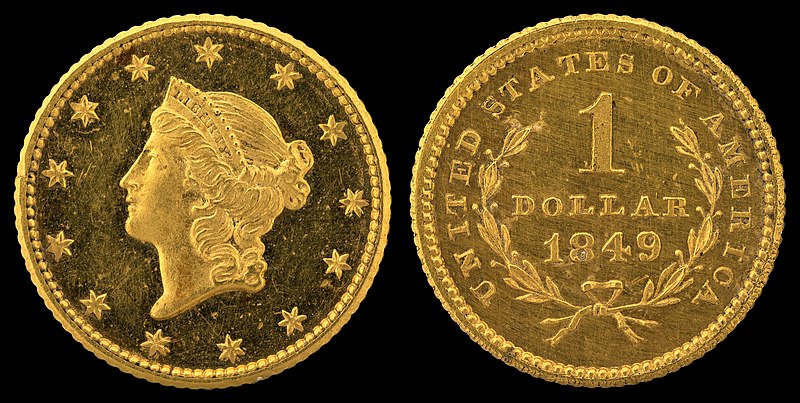
Gold dollar of United States ( Type 1)
The gold dollar or gold one-dollar piece was a coin struck as a regular issue by the United States Bureau of the Mint from 1849 to 1889. The coin had three types over its lifetime, all designed by Mint Chief Engraver James B. Longacre. The Type 1 issue had the smallest diameter of any United States coin ever minted.

A gold dollar had been proposed several times in the 1830s and 1840s, but was not initially adopted. Congress was finally galvanized into action by the increased supply of bullion caused by the California gold rush, and in 1849 authorized a gold dollar. In its early years, silver coins were being hoarded or exported, and the gold dollar found a ready place in commerce. Silver again circulated after Congress in 1853 required that new coins of that metal be made lighter, and the gold dollar became a rarity in commerce even before federal coins vanished from circulation because of the economic disruption caused by the American Civil War.
Gold did not again circulate in most of the nation until 1879; once it did, the gold dollar did not regain its place. In its final years, it was struck in small numbers, causing speculation by hoarders. It was also in demand to be mounted in jewelry. The regular issue gold dollar was last struck in 1889; the following year, Congress ended the series.
In 1831, the first gold dollar was minted, at the private mint of Christopher Bechtler in North Carolina. Much of the gold then being produced in the United States came from the mountains of North Carolina and Georgia, and the dollars and other small gold coins issued by Bechtler circulated through that region, and were now and then seen further away. Additional one-dollar pieces were struck by August Bechtler, Christopher's son.
| Design | Liberty wearing a coronet. Type 1. |
|---|---|
| Designer | James B. Longacre |
| Design date | 1849 |
| Design discontinued | 1854 |
A gold dollar had been proposed several times in the 1830s and 1840s, but was not initially adopted. Congress was finally galvanized into action by the increased supply of bullion caused by the California gold rush, and in 1849 authorized a gold dollar. In its early years, silver coins were being hoarded or exported, and the gold dollar found a ready place in commerce. Silver again circulated after Congress in 1853 required that new coins of that metal be made lighter, and the gold dollar became a rarity in commerce even before federal coins vanished from circulation because of the economic disruption caused by the American Civil War.
Gold did not again circulate in most of the nation until 1879; once it did, the gold dollar did not regain its place. In its final years, it was struck in small numbers, causing speculation by hoarders. It was also in demand to be mounted in jewelry. The regular issue gold dollar was last struck in 1889; the following year, Congress ended the series.
In 1831, the first gold dollar was minted, at the private mint of Christopher Bechtler in North Carolina. Much of the gold then being produced in the United States came from the mountains of North Carolina and Georgia, and the dollars and other small gold coins issued by Bechtler circulated through that region, and were now and then seen further away. Additional one-dollar pieces were struck by August Bechtler, Christopher's son.
Nickel Coins of United States with Monticello on reverse
A nickel, in American usage, is a five-cent coin struck by the United States Mint. Composed of 75% copper and 25% nickel, the piece has been issued since 1866. Its diameter is .835 inches (21.21mm) and its thickness is .077 inches (1.95 mm).
The silver half dime, equal to five cents, had been issued since the 1790s. The American Civil War caused economic hardship, driving gold and silver from circulation; in response, in place of low-value coins, the government at first issued paper currency. In 1865, Congress abolished the five-cent fractional currency note after Spencer M. Clark, head of the Currency Bureau (today the Bureau of Engraving and Printing), placed his own portrait on the denomination. After successful introduction of two-cent and three-cent pieces without precious metal, Congress also authorized a five-cent piece consisting of base metal; the Mint began striking this version in 1866.
The initial design of the Shield nickel was struck from 1866 until 1883, then was replaced by the Liberty Head nickel. The Buffalo nickel was introduced in 1913 as part of a drive to increase the beauty of American coinage; in 1938, the Jefferson nickel followed. In 2004 and 2005, special designs in honor of the bicentennial of the Lewis and Clark Expedition were issued. In 2006, the Mint reverted to using Jefferson nickel designer Felix Schlag's original reverse (or "tails" side), although a new obverse, by Jamie Franki, was substituted.

Jefferson designed the main house using neoclassical design principles described by Italian Renaissance architect Andrea Palladio, subsequently reworking the design through much of his presidency to include design elements popular in late 18th-century Europe and integrating numerous of his own design solutions. Situated on the summit of an 850-foot (260 m)-high peak in the Southwest Mountains south of the Rivanna Gap, the name Monticello derives from the Italian for "little mount". Along a prominent lane adjacent to the house, Mulberry Row, the plantation came to include numerous outbuildings for specialized functions, e.g., a nailery; quarters for domestic slaves; gardens for flowers, produce, and Jefferson's experiments in plant breeding — along with tobacco fields and mixed crops. Cabins for field slaves were located farther from the mansion.
The silver half dime, equal to five cents, had been issued since the 1790s. The American Civil War caused economic hardship, driving gold and silver from circulation; in response, in place of low-value coins, the government at first issued paper currency. In 1865, Congress abolished the five-cent fractional currency note after Spencer M. Clark, head of the Currency Bureau (today the Bureau of Engraving and Printing), placed his own portrait on the denomination. After successful introduction of two-cent and three-cent pieces without precious metal, Congress also authorized a five-cent piece consisting of base metal; the Mint began striking this version in 1866.
The initial design of the Shield nickel was struck from 1866 until 1883, then was replaced by the Liberty Head nickel. The Buffalo nickel was introduced in 1913 as part of a drive to increase the beauty of American coinage; in 1938, the Jefferson nickel followed. In 2004 and 2005, special designs in honor of the bicentennial of the Lewis and Clark Expedition were issued. In 2006, the Mint reverted to using Jefferson nickel designer Felix Schlag's original reverse (or "tails" side), although a new obverse, by Jamie Franki, was substituted.

Monticello shown on reverse was the primary plantation of Thomas Jefferson, the third President of the United States, who began designing and building Monticello at age 26 after inheriting land from his father. Located just outside Charlottesville, Virginia, in the Piedmont region, the plantation was originally 5,000 acres (20 km2), with Jefferson using slaves for extensive cultivation of tobacco and mixed crops, later shifting from tobacco cultivation to wheat in response to changing markets.
Jefferson designed the main house using neoclassical design principles described by Italian Renaissance architect Andrea Palladio, subsequently reworking the design through much of his presidency to include design elements popular in late 18th-century Europe and integrating numerous of his own design solutions. Situated on the summit of an 850-foot (260 m)-high peak in the Southwest Mountains south of the Rivanna Gap, the name Monticello derives from the Italian for "little mount". Along a prominent lane adjacent to the house, Mulberry Row, the plantation came to include numerous outbuildings for specialized functions, e.g., a nailery; quarters for domestic slaves; gardens for flowers, produce, and Jefferson's experiments in plant breeding — along with tobacco fields and mixed crops. Cabins for field slaves were located farther from the mansion.
At Jefferson's direction, he was buried on the grounds, in an area now designated as the Monticello Cemetery. The cemetery is owned by the Monticello Association, a society of his descendants through Martha Wayles Skelton Jefferson. After Jefferson's death, his daughter Martha Jefferson Randolph sold the property. In 1834 it was bought by Uriah P. Levy, a commodore in the U.S. Navy, who admired Jefferson and spent his own money to preserve the property. His nephew Jefferson Monroe Levy took over the property in 1879; he also invested considerable money to restore and preserve it. In 1923, Monroe Levy sold it to the Thomas Jefferson Foundation (TJF), which operates it as a house museum and educational institution. It has been designated a National Historic Landmark. In 1987 Monticello and the nearby University of Virginia, also designed by Jefferson, were together designated a UNESCO World Heritage Site.
Subscribe to:
Posts (Atom)